AI in agriculture: what it does from the field to the food plant
AI in agriculture is software that learns from farm and food data, such as satellite and drone images, machine readings and camera images of plants and produce, to guide decisions and machines. It helps vary inputs across a field, predicts crop yields, finds weeds with cameras, flags equipment for maintenance and inspects food on processing lines. In Canada, Statistics Canada and Agriculture and Agri-Food Canada (AAFC) have modelled preliminary crop yields from satellite data since 2016. This guide covers what each use does and needs, and what it means for farm equipment makers and food processors.

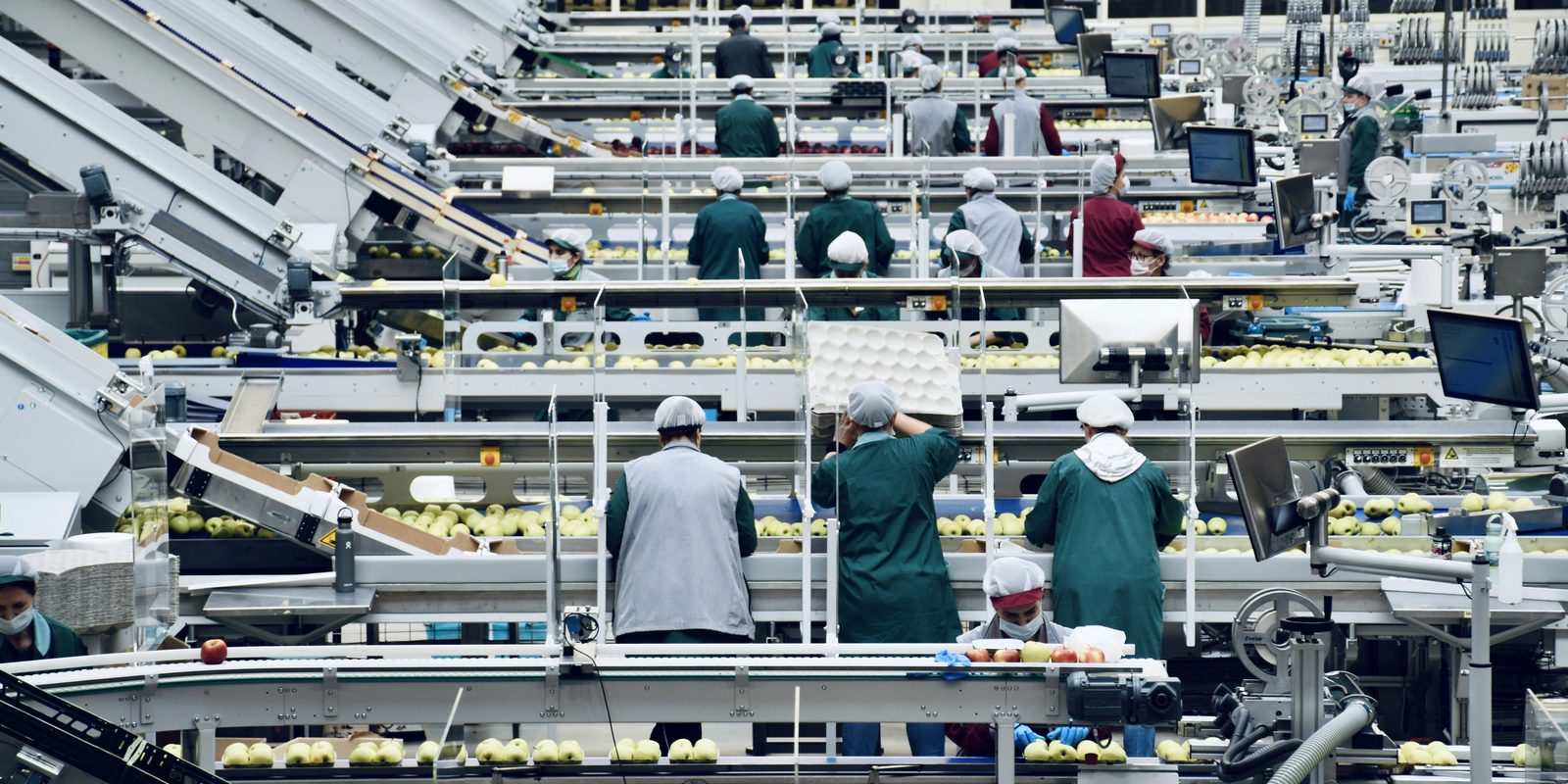
What AI does in agriculture today
The five uses below run from the field to the processing plant. The table sums them up, and the sections after it give the sources.
| Use | What the software does | What it needs | What to check |
|---|---|---|---|
| Precision agriculture | Steers machines and varies seed, fertilizer or spray rates across a field | GPS guidance, field maps and a tractor and implement that work together | Whether each implement works with each tractor terminal |
| Crop and yield prediction | Estimates yields from satellite, drone, weather and field data | Years of yield records and field data to train and test the model | The forecast against survey figures and your own harvest records |
| Machine vision for weeding | Finds weeds with cameras on the sprayer boom and sprays only the weeds | Cameras, a model trained on the crop and field conditions, and a compatible sprayer | The field conditions the model is sold for |
| Equipment telematics and maintenance | Sends machine alerts to the owner and the dealer, and flags potential failures | Connected machines and a dealer with access to their data | Which alerts need a service call, and which parts to order |
| Quality inspection in food plants | Detects defects and foreign material on the line and removes them | Good images from good sensors, training data and tolerances set by an operator | Samples pulled by a person to confirm the sorter’s calls |
Precision agriculture
Precision agriculture uses GPS guidance, sensors and field maps to treat each part of a field according to its needs, and it produces field data that later tools can learn from. In Statistics Canada’s 2021 Census of Agriculture, 26.8% of farms reported using auto-steer in 2020, 16.1% variable-rate input application, 13.2% GIS mapping and 3.6% drones. Variable-rate application means the machine changes the amount of seed or fertilizer as it crosses the field.
The tractor and the implement it pulls have to exchange data. The Agricultural Industry Electronics Foundation (AEF) says the ISO 11783 standard, known as ISOBUS, “defines the communication between agricultural machinery, mainly tractors and implements, and also the data transfer between these mobile machines and farm software applications.” It adds that the standard “leaves room for interpretation, which has led to a great number of innovative but proprietary ISOBUS solutions,” so the AEF writes guidelines that define ISOBUS functions more precisely.
Crop and yield prediction
Statistics Canada says that, with AAFC, it “has relied on proven satellite technology to model preliminary crop yields and production since 2016.” Its model-based estimates for the 2026 crop came out on September 16, 2026, and the final survey-based estimates follow on December 4, 2026. In July 2026, AAFC committed up to $1.65 million over three years to A.U.G. Signals Ltd. for tools that combine satellite, drone and field data to assess crop emergence, biomass, drought and yield. AAFC scientists work with the company on collecting field data and validating the AI models.
Machine vision for weeding
Machine vision is software that finds objects, such as weeds or bruised fruit, in camera images. John Deere says See & Spray Select uses “computer vision and advanced camera technology” to target spray weeds in fallow fields. Once the boom cameras spot a weed, Deere says, processors identify it “in milliseconds” and direct the nozzles to spray only that weed. Fallow fields are fields left unseeded for a season. In September 2026, AAFC committed up to $1,693,412 to Vivid Machines Inc. to adapt its camera technology from apple orchards to grape vineyards. The company will train new computer vision models to spot crop diseases early, track fruit quality and predict yields per vine, row and block.
Equipment telematics and maintenance
Telematics is the data a machine reports over a cellular or satellite link. On John Deere’s Connected Support page, an owner with a connected machine can monitor alerts, engine hours, utilization, location, fuel level and idle time. The dealer can monitor the same alerts, connect to the machine remotely for diagnosis and use Expert Alerts from John Deere “to address potential future downtime.” For how a maintenance model uses machine data, see predictive maintenance.
Quality inspection in food plants
Food processing is a large part of Canadian manufacturing. AAFC reports that in 2024 food and beverage processing was the country’s largest manufacturing industry by value of production, with sales of $173.4 billion, 20.3% of all manufacturing sales, and 318,400 employees. TOMRA, a maker of optical sorting machines, wrote in June 2025 that it has used machine learning in its products “for over a decade.” It named jobs such as identifying foreign materials and detecting product defects. It also wrote that “the key element of any artificial intelligence product is the data used to train the algorithm,” and that the processor sets “the tolerances on shape, size, and biological characteristics.” Computer vision in manufacturing covers what camera inspection takes inside a plant.
What AI in agriculture needs, and where it falls short
Each use depends on data and equipment that someone keeps in order:
- Years of records. Yield models learn from past fields and seasons, and Statistics Canada still publishes survey-based figures after its model-based ones.
- Machines that work together. The AEF’s own description of ISOBUS names proprietary variations as the reason it writes extra guidelines.
- Training data that matches your conditions. Deere sells See & Spray Select for fallow fields, and TOMRA names training data as the key element of its AI.
- A connection from the field. Telematics alerts reach the owner and the dealer only from connected machines.
- A person who sets the rules. An operator sets the sorting tolerances, and a person checks samples. Human in the loop explains how that approval step works.
Which records slow your team down
Tell Derik which orders, specifications or traceability records your team handles by hand. He reads every enquiry and usually replies within one business day.
Start a conversationAI in agriculture in Canada
In Statistics Canada’s survey for the second quarter of 2026, 4.5% of businesses in agriculture, forestry, fishing and hunting reported using AI to produce goods or deliver services over the previous 12 months. That was the lowest share of any industry named, against 19.2% of all businesses.
The Sustainable Canadian Agricultural Partnership is a $3.5-billion, five-year agreement that runs from April 1, 2023 to March 31, 2028. It includes $1 billion in federal programs and $2.5 billion in programs cost-shared by the federal, provincial and territorial governments. Both AAFC investments above came through its AgriScience Program. On August 26, 2026, the Minister of Industry announced $50 million for the Canadian Agri-Food Automation and Intelligence Network (CAAIN), which is expected to fund at least 40 new technology projects.
What it means for farm equipment makers and food processors
For a plant that makes farm equipment or parts, or a processor that buys from farms, AI in agriculture shows up in the records that reach the office.
Farm equipment makers and their dealers
A connected machine sends alerts to its owner and its dealer, and an implement has to work with the tractor terminal it plugs into. For the maker and its dealers, an alert can lead to a service call, a parts order or a warranty claim. An AI system can read dealer orders and warranty claims as they arrive, match them to part numbers in your ERP, and draft the reply for someone on your team to approve. AI for supply chain covers parts planning, and warehouse AI covers picking and staging.
Food processors
Under the Safe Food for Canadians Regulations, traceability means tracking food “forward to the immediate customer and back to the immediate supplier,” according to the Canadian Food Inspection Agency’s traceability page. The documents are kept for two years. If those records sit in separate receiving logs, batch sheets, supplier certificates and shipping documents, an AI system can link them by lot code. It can read supplier certificates with text extraction and answer a trace request from one place. The same records feed production scheduling and logistics.
Pick a finished lot from last month and ask the system for its immediate suppliers and immediate customers. Compare the answer with the paper trail your team would pull by hand, and note how long each took.
How ThriveAI helps
ThriveAI is an AI engineering company in Ottawa that builds private AI systems for manufacturers and distributors in Ontario and Quebec, on their own data. A plant that makes farm equipment parts, or a food processor, runs its office on quotes, orders, documents and the ERP like any other manufacturer.
ThriveAI brings what your ERP, email, drawings and spreadsheets hold into one database that belongs to your company. Your team asks it questions in plain language, and every answer shows where it came from. It also drafts routine work, such as order entries, purchase orders and quotes, for someone on your team to approve.
ThriveAI’s systems read your ERP and your other software as they are, including older versions installed on your own server. The platform ThriveAI builds on is designed to keep each client’s data on its own server in Canada. You choose the AI model that reads it: one on that server, or a hosted model under a written agreement that the provider keeps nothing after answering. A hosted model may process requests outside Canada, so the contract names the model and its service tier. Derik Lawlis, the founder, leads every project and stays close to the build, and working sessions run on site with your team, in French or English. For more, see private AI for business and About ThriveAI.