Physical AI, and what a plant needs on record before it applies
Physical AI is AI that perceives and acts in the physical world: robots, autonomous machines, machines that see. This page explains the term and separates what a manufacturer can buy this year from what is still research. It then names what has to be true inside a plant before any of it pays. It also states plainly what ThriveAI does not build.

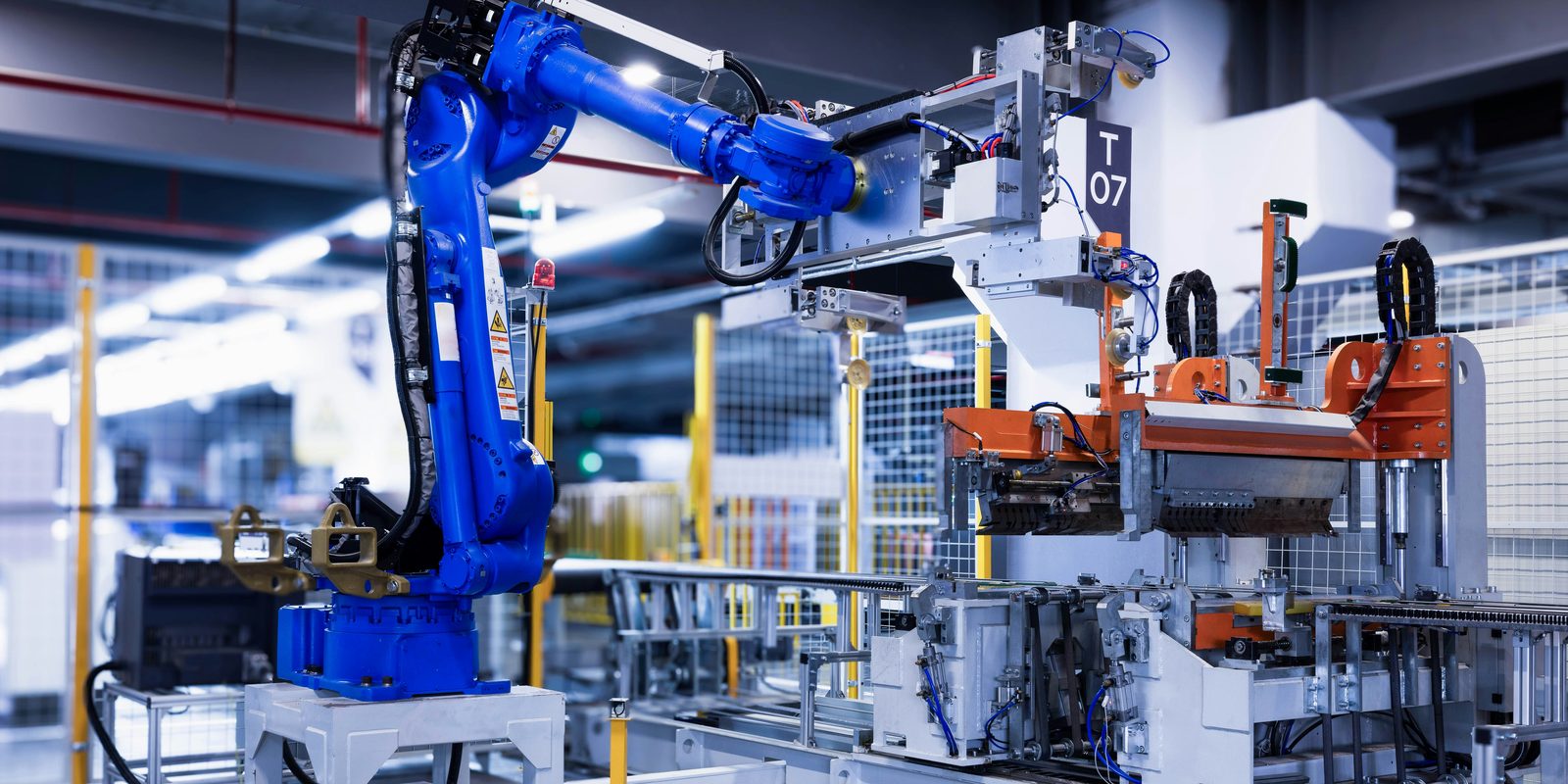
What physical AI means
Three sources carry the definition and they agree with each other. NVIDIA describes cameras, robots and self-driving cars that perceive, understand, reason and then perform or orchestrate complex actions in the physical world. IBM writes that these are AI systems which operate in and interact with the physical world, rather than existing only in software or digital environments. Wikipedia describes systems that perceive, reason about and act within the physical world. Two vendor glossaries and one encyclopedia entry land in the same place, so the term has a settled meaning.
The distinguishing property is embodiment. The system carries sensors and actuators, so its output is motion instead of a document. A chat answer and a robot arm are different products with different supply chains. One arrives as a login. The other arrives on a truck, and it needs floor space, guarding, a maintenance plan and somebody on staff who can program it.
The three layers
Three layers stack inside any physical AI system. The model decides. The sensors and actuators connect that decision to the world. The machine underneath carries both and takes the load.
Most industrial projects stall at the middle layer, because it is hardware. On a floor that layer is part presentation, fixturing, cabling and sensor mounting. Hardware has lead times and it wears. It also carries a safety case somebody has to sign.
The label gained its current currency during the 2020s, as attention moved from software AI toward embodied systems. The work under the label is older than that. Robotics and embodied intelligence research predates the term by decades, which is why a plant owner recognizes most of what a physical AI page describes.
What ships today, and what is still research
The term covers a robot you can order this quarter and a research checkpoint nobody sells. The search results put both under the same heading. The table separates them.
| Capability | Where it sits today | Evidence |
|---|---|---|
| Robot arms and cobots with AI running above the control layer | Purchasable | Universal Robots announced its Gen 7 platform on September 15, 2026, with an AI-ready tool flange built so vision and sensing run in real time with the robot |
| Machine vision inspection on a fixed station | Purchasable and mature | A long-standing category, sold and installed by integrators |
| Autonomous mobile robots in a warehouse | Purchasable | Named as a current application by IBM |
| A model that transfers to a new task in a new plant without retraining | Research | Physical Intelligence released pi-0.7 in April 2026 and describes it as a step-change in generalization |
| Millions of affordable general-purpose robots working unsupervised | Not close | CSET, February 2026 |
Checked September 22, 2026.
What the order book says
North American companies ordered 8,940 robots worth $622 million in the second quarter of 2026, on A3 figures reported by The Robot Report. Units rose 4.3 percent and value rose 21.3 percent against the same quarter of 2025. Non-automotive buyers took 56 percent of the units. That figure matters to a job shop, because it says the market has moved past its original customer.
Divide the value by the units and the average order lands near $70,000 per robot. That is arithmetic on the reported figures rather than a quoted price, and it covers the robot before integration, tooling, guarding and programming.
What the research says about the gap
John VerWey put the distance in writing for the Center for Security and Emerging Technology in an issue brief published in February 2026. His sentence: "the gap between impressive demonstrations in controlled environments and the promise of millions of affordable robots acting independently as they navigate the world is enormous."
The same brief names a constraint any buyer of capital equipment will recognize. Batteries, motors, sensors and actuators evolve far more slowly than algorithms and software. A servo or a sensor is qualified on a lead time and a service life the buyer can look up before ordering it.
What ThriveAI builds, and what it does not
ThriveAI does not build robots. It does not sell robot cells, machine vision rigs, autonomous vehicles, PLC or motion control, or hardware of any kind. There is no robotics practice here and no integrator partnership.
What it builds is the data warehouse a plant's own systems feed, and the software that reads it. Modules sit on that record for quoting, costing, scheduling, order entry, purchasing and forecasting. A named person approves every action, and what an agent is allowed to decide gets written down before anything runs. Data stays at rest on the client's own server in Canada, and inference runs on that server with an open-weight model or through a frontier model under a written zero-data-retention control with the model tier named.
That is one record of the business, on the plant's own server. It is also the part of a cell decision a plant of this size can build this year, and no robotics vendor supplies it.
Tell us which parts repeat
Send the list of parts you ran more than twenty times last year. We will tell you what your own systems can already say about them.
Start a conversationPhysical AI runs on a model of the world
The robotics labs build that model for the machine. It tracks where the gripper is, what the part weighs, and what happens when the part slips. That model comes from sensors and from training, and it is the vendor's problem to solve.
A plant runs on a second model, and that one decides whether a machine is worth installing. It answers which parts repeat, what each job costs, and how long the work actually takes against what the router says. It also holds what was promised and what shipped. A cell is justified against a part that repeats at a known volume, at a known cost, with a known run time. Those facts live in a record, not in a sensor reading.
One shape of that record, with numbers invented to show the columns rather than to describe any plant.
| Part number | Runs last year | Recorded cost | Recorded run time | Router run time | Gap |
|---|---|---|---|---|---|
| A-1042 | 214 | $38.60 | 11.4 min | 8.0 min | 3.4 min over |
| B-2210 | 96 | $127.15 | 42.0 min | 45.0 min | 3.0 min under |
| D-5580 | 48 | not recorded | not recorded | 26.0 min | not known |
A plant that cannot answer those questions from its own systems cannot size a cell, and cannot put a payback in front of a lender. It also cannot tell afterwards whether the cell worked, because there is no measured before to compare against.
At a machine shop, the CAM post now writes part handling into the G-code instead of a programmer editing it in afterwards. It is in production and the shop maintains the file itself.
The output is still a program a machinist reads before the spindle turns, and a free browser tool will check the toolpath before it runs.
What has to be true on your floor first
Statistics Canada's Survey of Advanced Technology put manufacturers at the top of robotics adoption for its 2022 reference year, at 8.4 percent. Read the same survey by company size and the picture changes. Large enterprises ran at 9.1 percent, medium ones at 5.3 percent, and small ones at 1.6 percent.
The record underneath is thinner again. ICTC and NGen surveyed Canadian advanced manufacturers for Accelerating Digital Transformation in Canada's Advanced Manufacturing Sector, reported on July 14, 2026. Of those surveyed, 57 percent use digital technologies in isolated applications or partially networked environments. Five percent use connected technologies for predictive analytics, and 4 percent have reached the point where data supports autonomous decision-making.
Read together, the two surveys point at the same constraint. The robot is available to buy. The numbers that decide whether to buy it are the part most plants of this size cannot produce.
Six checks, and an afternoon is enough to run them.
- Pull the list of parts you ran more than twenty times last year. If producing that list takes more than a morning, start there.
- Put a real cost against each one. Material at what it actually cost, time at what the job actually took, setup counted separately from run.
- Compare the run time on the record against the run time on the router, and write down the gap.
- Count how many of those parts arrive as a drawing in an email rather than as a record in the ERP. A tool can read a dimension off a scanned drawing, and you can open a STEP file in the browser without a CAD seat.
- Check whether the same part number means the same thing in the ERP, the quote file and the drawing folder.
- Write down who signs off when a number changes, and where that decision is recorded.
A plant that clears all six can evaluate a cell on its merits, and can check the integrator's payback model against its own figures. A plant that clears none of them has a data problem to solve before a robotics decision.
Where that leaves an owner this year
The work available this year sits at the desks rather than on the floor. Three of those desks carry public benchmarks, so an owner can size the gap before spending anything.
Quoting comes first. Top Shops 2025 is Modern Machine Shop's annual benchmarking survey of North American machining operations. The top fifth turn a quote in one day and book 19 percent more of what they quote. Across a wider sample, 71 percent say a quote takes at least a day to produce. TrendCandy surveyed 200 decision-makers at US manufacturers, wholesalers and distributors in July 2025 for the 2025 Built to Sell Report.
Delivery dates are the second. Industry-average on-time delivery among metal fabricators runs at 84 percent, against better than 90 percent for the top quartile. That comes from the FMA Financial Ratios and Operational Benchmarking Survey, as cited by Infor.
Costing is the third, and it carries no external benchmark. Shops cost parts differently enough that a published average does not transfer, and a number invented for this page would be worse than none.
A distributor reads the same desks differently. Order entry and pick accuracy carry the work there, and the repeat-volume test in the readiness list runs on SKUs rather than part numbers. A warehouse robot decision reads that same record.
The record that fixes those three desks is the record a cell decision needs later. Building it is not a robotics project and does not wait on one. The desk-by-desk version is AI for manufacturing, and the architecture underneath it is one record of the business, on the plant's own server.
Federal and provincial programs fund this class of work for manufacturers of this size. The NRC Industrial Research Assistance Program advises and funds Canadian small and medium-sized businesses on technology projects.
Derik at Thrive was instrumental in taking incredibly messy data we inherited in a business we acquired and, through using AI, organized it in record time in a way that made it reviewable by our team for final review and approval. He proposed solutions that were effective to implement and everyone on our team was impressed and happy to work with him.
Rios-Karim Mercier, Belmont Capital.
What to ask before you buy a cell
Take this list into any integrator meeting. It names no vendor and it works whoever you end up buying from.
- Which specific part numbers does this cell run, and how many of each did we make last year.
- What is the cycle time today, measured from our own job records rather than from the router.
- What does the cell do when the part arrives at a revision it has not seen before.
- Who changes the program, and what happens when that person is on vacation.
- What sensing does it need, and what happens when a sensor drifts out of calibration.
- What is the guarding, training and validation cost, counted separately from the arm.
- What does the payback calculation assume about volume, and where did that volume number come from.
- What record does the cell write back, and can we read that record without the vendor.
Question six is the one that surprises a first-time buyer. ISO 10218-1 and ISO 10218-2, both revised in 2025, set the safety requirements for an industrial robot installation, and the 2025 edition of part 2 now carries most of the collaborative-application requirements, including force limits, that used to sit in ISO/TS 15066. A risk assessment against them covers the reach envelope, the guarding and the speed the cell runs at with a person inside it. It also covers the test that proves the forces stay within the limit. Somebody has to sign that assessment, and at 20 to 200 people that is usually the owner.
Questions two, seven and eight get answered from the plant's own record, which is why the record comes first.