AI in mining: what it does at the mine and what it means for suppliers
AI in mining is software that learns from sensor, machine and geoscience data. At a mine it predicts equipment failures, grades ore as it is dug, runs haul trucks without drivers and points exploration toward likely deposits. In a Statistics Canada table for the second quarter of 2026, 13.4% of businesses in mining, quarrying, and oil and gas extraction used AI, against 19.2% of all businesses. This guide covers what each use does and needs, and what it means for a manufacturer or distributor that supplies mines with parts, maintenance and rebuilds.

What AI does in mining today
The five uses below run from exploration to the mill. The table sums them up, and the sections after it give the sources.
| Use | What the software does | What it needs | What to check |
|---|---|---|---|
| Predictive maintenance | Watches sensor data from trucks, shovels and mill drives and flags parts likely to fail | Sensors on the equipment, a data link and a record of past failures | Which alerts lead to a planned repair, and which parts must be on hand |
| Ore sorting and tracking | Measures ore grade in the shovel bucket and routes each load to the mill, stockpile or waste | Sensors on the shovel, models built for the ore body and a fleet management system | Sensor grades against laboratory assays of the same material |
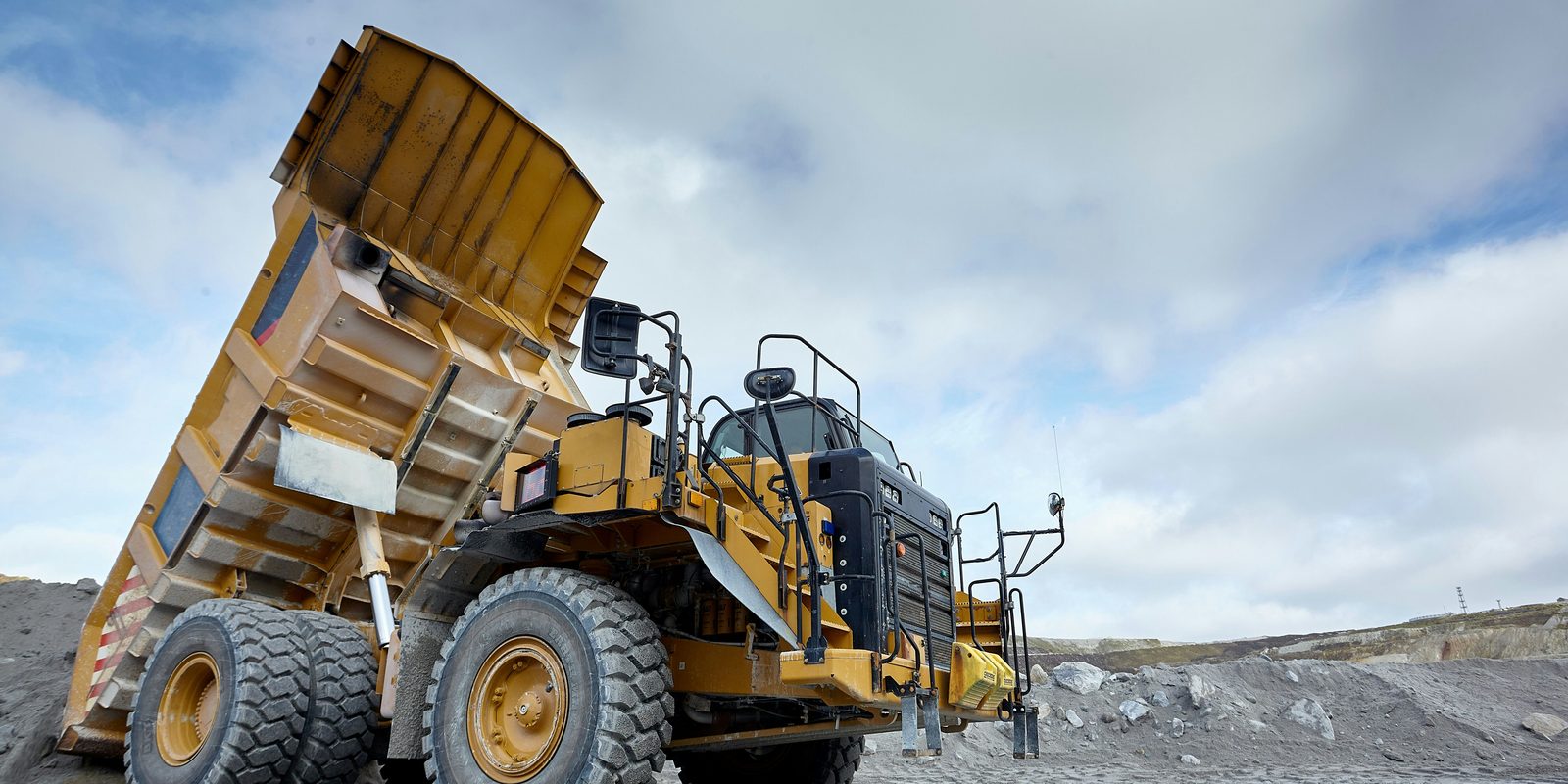
| Autonomous haulage | Drives haul trucks on the mine’s roads under control from a central room | GPS, a wireless network across the site, perception sensors and control room operators | How the fleet shares roads with people and light vehicles |
| Safety monitoring | Detects obstacles, and vehicles that come too close to each other | Collision and proximity detection on each vehicle | The vehicles and people the system does not cover |
| Exploration data | Maps where a type of deposit is likely from national geology data | Geoscience data and known deposits to learn from | The map against drilling results |
Predictive maintenance on haul trucks and mills
Predictive maintenance uses sensor data to find a part that is wearing out and fix it before it fails. Teck Resources said in April 2022 that “predictive maintenance enabled by equipment sensors has reduced equipment downtime and operational interruptions across all sites.” At its Fording River Operations, machine learning models use truck speed and location to spot road maintenance tasks and allocate trucks.
A SAG mill is a large rotating drum that grinds ore with the rock itself and steel balls, and a ball mill grinds with steel balls alone. ABB described in October 2023 its remote monitoring of the gearless drives that turn these mills, on a cloud platform for predictive maintenance that uses machine learning. ABB said it was monitoring almost 40 of these drives for clients around the world. Predictive maintenance covers the method in a smaller plant.
Ore sorting and ore tracking
Ore sorting sends each load to the right place based on its grade, the share of metal it contains. MineSense says its ShovelSense system reads the shovel bucket with X-ray fluorescence sensors, which measure elements by the X-rays they give off. It processes the data with “machine learning algorithms developed for that ore body.” The result goes to the fleet management system, which directs each truck to the mill, a stockpile or waste.
At Highland Valley Copper in British Columbia, Teck wrote in November 2022 that machine learning tracks ore characteristics into the plant and recommends conveyor adjustments for the blend that reaches the grinding mills. It also gives frontline operators recommended equipment settings and chemical additions. Teck reported that in 2021 mill throughput rose 15% and copper recovery 3%, results of a program in which machine learning works alongside automation and other process control technologies.
Autonomous haulage
Suncor said on June 30, 2025 that all ore at its Base Plant oil sands mining operation near Fort McMurray, Alberta, is moved by autonomous haul trucks. It has almost 120 of these trucks across its two mines there. The system uses GPS, wireless LTE communication and “perceptive technologies,” and operators in a central control room manage the trucks. Suncor lists collision and obstacle detection among its features. Physical AI covers what machines that act on their own need from the plant around them.
Safety monitoring
Safety systems at mines watch vehicles and the people around them. In the same April 2022 release, Teck said light vehicle monitoring, collision and proximity detection and autonomous haulage “contributed to a 38% reduction” in its high-potential incident frequency in 2021 compared with the previous year. High-potential incidents are events that could have caused serious harm. Teck gives the figure for the set of initiatives together.
Exploration data
A prospectivity model maps where a type of deposit is likely, based on geology, geophysics and the locations of known deposits. The Geological Survey of Canada leads the federal research component of the Critical Minerals Geoscience and Data Initiative. One of its aims is to “develop innovative applications of artificial intelligence and machine learning to support national-scale models and assessments of critical minerals potential.” Its national models for carbonatite-hosted rare earth element deposits, built with machine learning, “reduce the search area by 80%, while predicting all known occurrences.”
What AI in mining needs, and where it falls short
Each use depends on equipment and data that the mine keeps in order:
- Sensors and a site network. Suncor’s trucks run on GPS, wireless LTE and perception sensors, and Teck’s predictive maintenance runs on equipment sensors.
- Models built for the deposit. MineSense says its algorithms are developed for each ore body.
- Known examples to learn from. The Geological Survey of Canada reports its rare earth model’s result against all known occurrences.
- People in the loop. Teck’s mill models recommend settings to operators, and Suncor’s trucks answer to a control room. Human in the loop explains how that approval step works.
Company results are hard to pin on one tool. Teck reports its gains for programs that combine machine learning with automation and process control, and its safety figure for a set of initiatives.
Which mine orders slow your team down
Tell Derik which parts orders, rebuild quotes or work orders your team handles by hand. He reads every enquiry and usually replies within one business day.
Start a conversationAI in mining in Canada
In the Statistics Canada table for the second quarter of 2026, 13.4% of businesses in mining, quarrying, and oil and gas extraction reported using AI to produce goods or deliver services over the previous 12 months. The share was 13.1% in manufacturing and 19.2% across all businesses. Natural Resources Canada reports that in 2024 the minerals and metals sector contributed $112 billion directly to Canada’s GDP. With indirect effects, the total was $156 billion, 5% of GDP.
Ontario’s Critical Minerals Innovation Fund pays up to 50% of eligible costs, to a maximum of $500,000 per project. It supports research, development and commercialization of new technologies for critical minerals, according to its program page, updated August 26, 2026. On July 9, 2026, the federal government announced $6.7 million through Canada’s Digital Technology Cluster for two mining projects. One is Novamera’s technology, which combines subsurface imaging, artificial intelligence, robotics and conventional drilling equipment to reach critical mineral deposits with greater precision.
What it means for manufacturers and distributors that supply mines
A plant that makes wear parts, a shop that rebuilds engines and final drives, or a distributor of parts and consumables can see mine AI in the orders and work it receives. The office work is the same as in any plant: quotes, orders, documents and the ERP.
Parts orders
When a mine plans repairs from sensor alerts, a parts order can arrive with the machine, the component and the date the part is needed. An AI system can read those orders from email and PDF, match them to part numbers in your ERP, check stock and draft the quote for someone on your team to approve. AI for supply chain covers order entry, buying and promise dates for a small team, and warehouse AI and AI for logistics cover picking and shipping.
Maintenance and rebuilds
A rebuild quote draws on inspection findings, machine hours, past rebuilds of the same component and a parts list. An AI system can read teardown reports and scanned work orders with text extraction, pull the parts history, and draft the quote and the work order for a service manager to approve. Production scheduling covers planning the shop’s work.
Ask which condition data the mine can share, such as hours, fault codes, oil analysis or wear measurements, and in what format. Ask how often the data arrives and who on the mine’s side approves a rebuild quote.
How ThriveAI helps
ThriveAI is an AI engineering company in Ottawa that builds private AI systems for manufacturers and distributors in Ontario and Quebec, on their own data. A plant that makes parts for mines, a rebuild shop or a distributor that supplies them runs its office on quotes, orders, documents and the ERP like any other manufacturer or distributor.
ThriveAI brings what your ERP, email, drawings and spreadsheets hold into one database that belongs to your company. Your team asks it questions in plain language, and every answer shows where it came from. It also drafts routine work, such as order entries, purchase orders and quotes, for someone on your team to approve. Anything going to a customer or a supplier waits as a draft until someone on your team sends it.
ThriveAI’s systems read your ERP and your other software as they are, including older versions installed on your own server. The platform ThriveAI builds on is designed to keep each client’s data on its own server in Canada. You choose the AI model that reads it: one on that server, or a hosted model under a written agreement that the provider keeps nothing after answering. A hosted model may process requests outside Canada, so the contract names the model and its service tier. Derik Lawlis, the founder, leads every project and stays close to the build, and working sessions run on site with your team, in French or English. For more, see private AI for business and About ThriveAI. AI strategy covers how to pick a first project, and cost of AI covers what you pay for.